
Environmental Sensing
Developing novel approaches that illuminate ecohydrological patterns and processes through advanced remote sensing and monitoring technologies
Environmental Sensing Research
Our environmental sensing research focuses on creating innovative measurement techniques, developing open-source software tools, and advancing environmental monitoring capabilities. We design and deploy sensor networks, develop remote sensing applications, and create analytical tools that enable new scientific discoveries.
Research Focus
Environmental monitoring in remote and resource-limited settings requires innovative technological solutions. We develop cost-effective, robust sensor systems that can operate reliably in challenging field conditions.
Our work bridges the gap between technological innovation and scientific application, creating tools that enable new research questions and improve our understanding of environmental processes.
Methodological Approach
We combine hardware development, software engineering, and data science to create integrated monitoring solutions. Our approach emphasizes open-source development and community-driven innovation.
From satellite-based remote sensing to ground-based sensor networks, we work across scales to develop comprehensive monitoring systems for environmental research and management.
Key Research Areas
Our environmental sensing research spans multiple interconnected areas of technology development
Remote Sensing
Satellite and airborne remote sensing of vegetation dynamics, water cycles, and land cover change, including hyperspectral and thermal infrared applications.
Sensor Networks
Wireless sensor networks for environmental monitoring, including soil moisture, weather stations, and plant physiological measurements in remote locations.
IoT Systems
Internet of Things (IoT) applications for agricultural monitoring, including crop sensing, irrigation management, and real-time data transmission from field sites.
Open-Source Software
Development of open-source software tools for environmental data analysis, including R packages, Python libraries, and web-based applications for the research community.
Machine Learning
Machine learning applications for environmental monitoring, including image classification, time series analysis, and predictive modeling for agricultural and ecological systems.
Data Integration
Methods for integrating multi-source environmental data, including sensor fusion, data quality assessment, and creating comprehensive datasets from diverse monitoring systems.
Technology Highlights
Examples of innovative sensing technologies developed by our lab
Arable Crop Intelligence Systems
Integrated crop monitoring platforms (Arable Mark 3) that capture weather, plant, soil, and irrigation data along with daily crop imagery. These systems provide comprehensive environmental sensing at the field scale, combining multiple measurement modalities in a single integrated device.
Used across our field research sites to monitor soil moisture, temperature, weather conditions, and vegetation status. The integrated camera enables visual crop phenology monitoring alongside precise environmental measurements.
Multi-Modal Sensing
Combines soil, weather, plant, and imagery data in integrated platforms
Autonomous Robotics
Robotic systems for automated, high-frequency spatial measurements
Fluxbot: Automated Soil Carbon Flux Measurement
Autonomous robotic soil carbon flux chambers that enable high-frequency, spatially distributed measurement of soil respiration and carbon cycling. Fluxbots can be deployed as arrays to capture soil process heterogeneity at centimeter to meter scales.
Our fluxbot arrays deployed in East African savanna ecosystems enable novel insights into ecosystem carbon dynamics and heterogeneity. The open-source, wireless design makes this technology accessible for collaborative research globally.
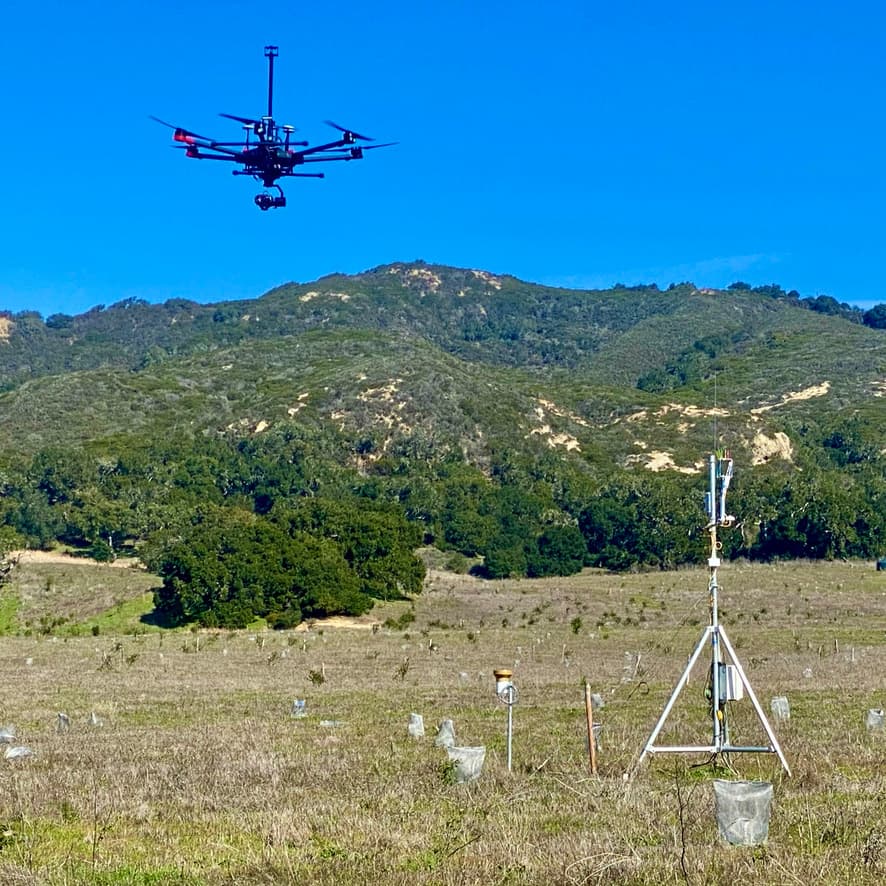
Unmanned Aerial Vehicle (UAV) Remote Sensing
Drone-based platforms for high-resolution aerial surveys, including thermal imaging, multispectral photography, and structure-from-motion photogrammetry. UAVs enable spatial resolution and revisit frequency that bridge ground sensors and satellite platforms.
We use UAVs for vegetation mapping, water stress assessment, thermal remote sensing of riparian systems, and landscape-scale environmental monitoring. UAV data is integrated with ground-based measurements to provide multi-scale understanding of ecohydrological processes.
Multi-Scale Integration
UAV data bridges ground sensors and satellite observations for comprehensive monitoring
Recent Environmental Sensing Publications
Latest research in environmental sensing and measurement technologies
Estimating whole-tree sap flow in buttressed and irregular trunks
Michael W. Burnett, Rayna Ruggeri, Kelly Caylor, Hillary S. Young, L. Anderegg (2026) • Agricultural and Forest Meteorology
Wind stress effects on drone-based thermal infrared surface velocimetry measurements of tidal flow in an estuary
E. Heberlein, Marc Mayes, Bryn Morgan, Kelly Caylor, S.A. Schweitzer, E.A. Cowen (2025) • Water Resources Research
We evaluate the effect of surface wind stress on remote velocimetry measurements of tidal flow by comparing these measurements to the bulk flow velocity measured by a co-located acoustic velocity profiler in a tidal channel. The remote velocity measurements are made with a thermal imager mounted on a drone hovering directly over the acoustic measurement location. Drones are a useful platform to support a variety of cameras and sensors for capturing images that can be used to infer surface velocities. Drone-mounted thermal infrared microbolometer cameras are a lower-cost infrared imaging solution that can detect subtle temperature patterns which naturally occur at the surface of many flows. These thermal patterns are used as signals for pattern-tracking to produce velocity measurements across the observed water surface. Drone flights were conducted at Carpinteria Salt Marsh Reserve (California, USA). Wind speed and direction relative to the flow direction caused the drone-based surface velocimetry measurements to deviate from in-channel surface-extrapolated acoustic velocity measurements. Drone-based velocity measurements were slower than in-channel velocity measurements when the parallel wind stress direction was opposite the tidal flow, while drone-based velocity measurements were faster than in-channel velocity measurements when the parallel wind stress and tidal flow were in the same direction. The effect of wind stress on remote surface velocimetry measurements is relatively unstudied, and herein we quantify this effect by comparing image-derived estimates to in-channel velocity measurements. This experiment also demonstrates the feasibility of drone-based thermal surface velocimetry measurements in an estuary.
Using hyperspectral and thermal imagery to monitor stress of Southern California plant species during the 2013–2015 drought
Susan K. Meerdink, Dar A. Roberts, Jennifer Y. King, K. Roth, Paul D. Gader, Kelly Caylor (2025) • Isprs Journal of Photogrammetry and Remote Sensing
Explore Our Research
Learn more about our other research themes and discover how environmental sensing connects with ecohydrology and human systems research.